
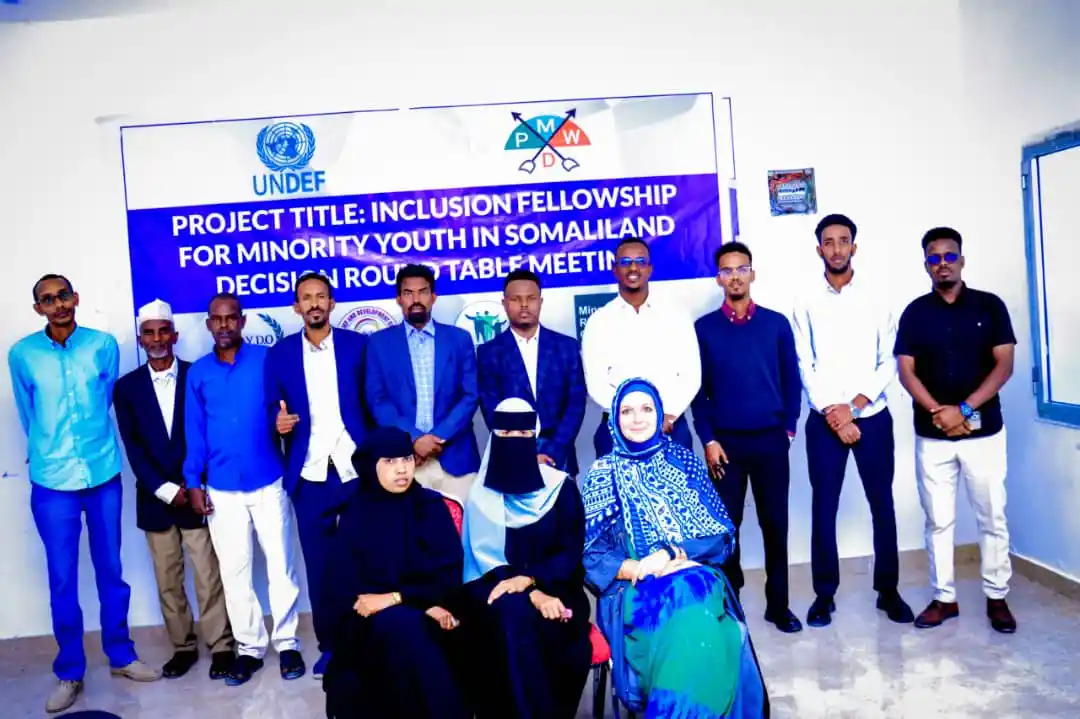
Hargeisa – A one-day roundtable on Inclusion Fellowships for Minority Youth in Somaliland, organized by the Daami Youth Development Organization (DYDO), was successfully held on 30 December 2025 at the Imperial Hotel in Hargeisa.
The event convened 15 representatives from institutions hosting project fellows—including SONSAF, SONYO, and the National Human Rights Commission—to strengthen collaboration, share progress, and discuss strategies for enhancing the participation of minority youth in governance and decision-making.
During the discussions, officers from the host institutions shared their experiences, reflections, and perspectives on the fellowship placements, emphasizing the value of collaboration, mentorship, and institutional engagement. Fellows also spoke about the benefits of the program, citing increased professional exposure, greater confidence, opportunities to engage in decision-making environments, and stronger links between their communities and public institutions.

This roundtable is part of the broader project “Inclusion Fellowships for Minority Youth in Somaliland,” implemented by DYDO in partnership with the United Nations Democracy Fund (UNDEF) and Minority Rights Group International (MRG) as the international implementing partner. The initiative places young professionals from minority communities into local government and public institutions, helping to bridge trust gaps, promote diversity, and advance inclusive governance.
Participants reaffirmed their commitment to supporting minority fellows, strengthening mentorship, and co-developing strategies to ensure sustainability, institutional engagement, and long-term inclusion outcomes.
Among the beneficiaries of the program was Mr. Abdigani Said Jama from Borame in the Awdal region.
“In a world often fixated on university degrees, vocational training offers a powerful and pragmatic path for youth, building stronger economies and more fulfilled individuals,” he said. “This hands-on education is far more than just an ‘alternative’—it’s a direct launchpad into a meaningful career.” Mr. Abdigani added that after two years in the fellowship, he is now equipped with the necessary skills for employment.
Another graduate, Ms. Hinda Ahmed Jama, who also completed two years in the program, stated, “With my newly acquired skills, I can now fully utilize and harness my potential.”
Mr. Ahmed Mohamoud, Executive Director of the Somaliland Youth Umbrella (SONYO), the organization tasked with training the youth, noted, “Our organization strives to prepare youth for direct employability.” He explained that graduates gain job-ready skills from day one, significantly shortening the transition from education to employment and addressing critical skills gaps in talent-hungry industries. “Modern vocational training is at the forefront of technology,” he added, “preparing youth for the jobs of the future in fields like robotics, cybersecurity, coding, and multimedia.”
A representative from the Somaliland Human Rights Commission, speaking at the event, emphasized, “Empowering our youth goes beyond the workshop. The impact transcends technical proficiency. These programs foster critical soft skills—punctuality, teamwork, problem-solving, and communication—within a collaborative environment. For learners who thrive outside a conventional lecture hall, vocational training can reignite engagement and self-belief, providing a clear vision for their future.


